Counting the Beautiful Butterflies of West Tennessee’s State Natural Areas

Tiger Swallowtail/Ron Zucker
Allan Trently and a group of volunteers led by Bart Jones got to count some of Tennessee’s most beautiful insects—butterflies! This past spring, Trently joined volunteers to count butterflies in West Tennessee State Natural Areas and State Parks. He serves as the West Tennessee Stewardship Ecologist with the Tennessee Department of Environment and Conservation’s Division of Natural Areas.
Each year, nine butterfly counts are held across West Tennessee. The counts have been taking place since the mid-1990s.
“The counts give us important information on how butterfly populations are doing. With 30 years of data, we can see where there are increases or decreases in numbers,” said Trently.
Spring Butterfly Count
The West Tennessee spring butterfly count season started with the Clifton Bend count on April 11. Seven volunteers identified and counted butterflies in the Carroll Cabin Barrens State Natural Area in Bath Springs, Tennessee.
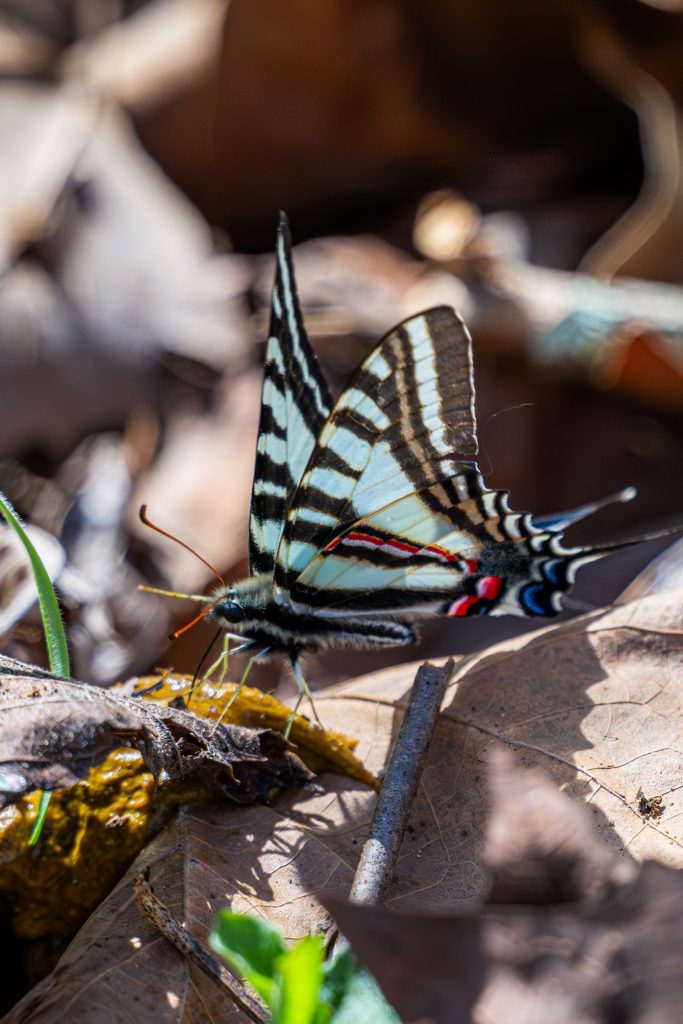
“The group counted many Dusted Skippers in the barrens. We also counted butterflies at the highest point in the natural area. There we encountered numerous butterflies participating in a natural phenomenon called hilltopping. Hilltopping is a behavior observed in many butterfly species, where males fly to the tops of hills to find mates. On the hill, we saw numerous Tiger and Zebra Swallowtails. Other butterflies of note during the count were Henry’s Elfins and a Giant Swallowtail,” said Trently.
The second spring count was at Meeman-Shelby Forest State Park and Natural Area. There, volunteers counted eight Pepper and Salt Skippers, 31 Monarchs, a Southern Pearly-Eye (a first for this count), and a Phaon Crescent, an uncommon butterfly in Tennessee.
Monarch Migration
Not all butterflies migrate. However, Tennessee serves as an important fueling station for Eastern Monarch butterflies during their migration. The Monarch butterfly’s annual migration between Mexico and Canada relies on an incredible intergenerational relay team.
Monarchs returning from Mexico arrive in Tennessee early each spring. They rely exclusively on native milkweeds, such as butterfly weed and common milkweed, to refuel and lay eggs for the next generation. Trently noted that it takes four distinct generations to complete the entire round-trip journey.
Summer Counts
This summer’s butterfly counts will include sites in Jackson, Decatur County, Lower Hatchie River, Reelfoot Lake State Park, and Meeman-Shelby Forest State Park and State Natural Area.